
Negative Certificate Translation
Certified translations for citizenship, residence and official use in Germany
A Negative Certificate is an official document confirming that a specific record, entry or legal status does not exist. It may state, for example, that no registration, no citizenship record, no marriage record or no particular administrative entry has been found.
In Germany, this type of document is often required for citizenship applications, residence matters, marriage procedures, pension issues, inheritance cases, legal matters or submission to public authorities.
Nachtigal Services provides certified translations of Negative Certificates into German for official use, with careful attention to legal wording, stamps, annotations, signatures, authority names and the exact meaning of the original document.
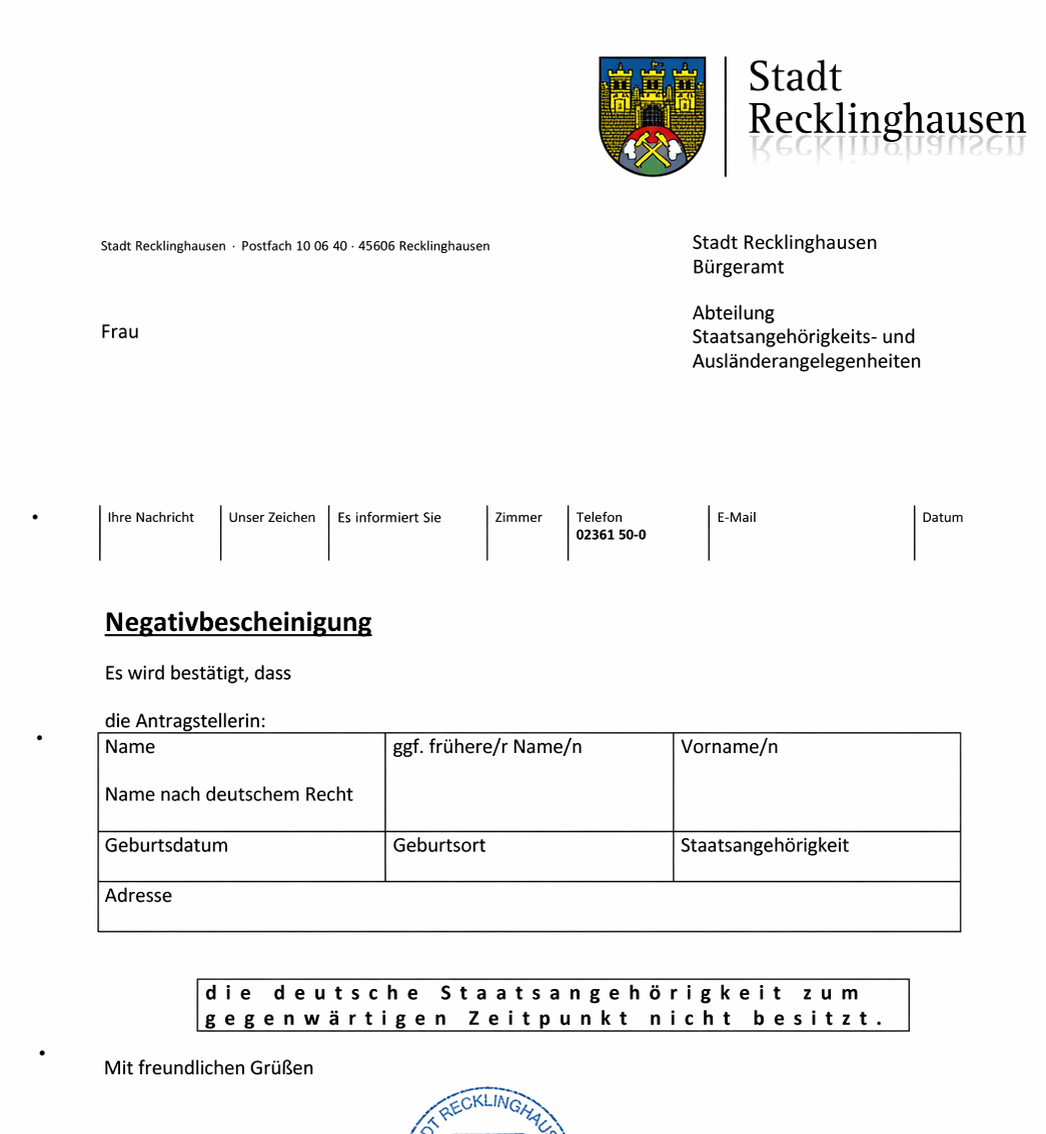
What is a Negative Certificate?
A Negative Certificate is issued by an authority to confirm the absence of a particular fact, record or legal status. Unlike many official documents, it does not prove that something exists. Instead, it confirms that a specific entry or condition is not recorded or does not apply.
This makes the wording especially sensitive. The difference between "not registered", "not found", "does not exist", "no record available" or "no entry has been made" can be important for the receiving authority.
Negative Certificate for citizenship matters
A Negative Certificate may be required in citizenship and naturalization procedures when an authority needs confirmation that a particular citizenship status, registration or legal record is absent.
For German authorities, the translation must clearly show what exactly was checked, which authority issued the certificate and what legal conclusion the document confirms. Ambiguous wording can lead to follow-up questions or delays.
When is a Negative Certificate translation needed?
A certified translation of a Negative Certificate may be needed for citizenship applications, residence permits, marriage registration, inheritance matters, pension procedures, civil status issues, court files or administrative procedures in Germany.
It may also be required when several documents must be compared, for example passport records, birth certificates, marriage documents, divorce records, residence documents or previous official confirmations.
Why accuracy is especially important
Because a Negative Certificate confirms the absence of a record rather than the existence of one, accuracy in translation is particularly important. Even small linguistic errors can change the meaning of the document.
A mistranslated negative statement may create uncertainty about whether an entry was never made, could not be found, has no legal effect or does not exist under the relevant administrative system.
Certified translation for German authorities
In many official procedures, German authorities require a certified translation prepared by an authorized translator. This applies not only to the main text of the certificate, but also to stamps, annotations, signatures, official titles, file numbers and authority names.
A certified translation confirms that the translation is complete and accurate. It helps the receiving office understand the legal and administrative function of the original document.
Official designations and administrative wording
Negative Certificates often contain administrative terminology that does not have a simple everyday equivalent in English or German. Terms relating to registers, entries, civil status, citizenship, residence, archival searches or official records must be translated according to context.
For English-speaking clients, clarity is particularly important. A well-prepared German translation helps authorities, lawyers, employers and institutions understand the purpose and legal meaning of the certificate.
What information must be translated?
Relevant information may include the applicant's name, date of birth, place of birth, citizenship, address, issuing authority, date of issue, file number, register reference, official statement, stamps, seals, signatures, apostilles and any additional remarks.
If the document contains a reverse side, apostille, certification page, verification page, QR code or attached explanation, these pages should also be submitted for assessment so that the translation scope is complete.
Negative Certificate from foreign authorities
Negative Certificates may be issued by civil registry offices, citizenship authorities, archives, courts, municipal offices, consulates or other public institutions. Their format and wording vary depending on the country and authority.
For German use, the translation must preserve the original meaning while making the function of the document understandable to the receiving authority.
Apostille, legalisation and document requirements
Some receiving authorities may require the original Negative Certificate to carry an apostille or legalisation before it is translated. If required, the usual sequence is: original document, apostille or legalisation, then certified translation.
This is important because the apostille or legalisation may also need to be translated. Please check the exact requirements with the receiving German authority before ordering the translation.
Common risks in Negative Certificate translation
Problems often arise from vague negative wording, missing pages, incomplete scans, unclear stamps, inconsistent names, untranslated apostilles or differences between the certificate and other documents in the application file.
To avoid delays, please submit the full document set and, where relevant, provide any preferred spelling of names already used in passports, residence permits, citizenship documents or previous certified translations.
Who needs a Negative Certificate translation?
Citizenship and naturalization applicants
Applicants may need a translated Negative Certificate to prove that a certain citizenship-related status, entry or record does not exist.
People dealing with residence or civil status matters
Residence authorities, registry offices and civil status offices may require a certified translation when the certificate supports an application or clarifies missing records.
Lawyers, notaries and public authorities
Legal professionals and authorities may need a precise translation for inheritance, pension, court, administrative or personal status procedures.
Nachtigal Services translates Negative Certificates, no-record certificates, citizenship-related confirmations, registry statements, apostilles and related official documents into German.
How to order your Negative Certificate translation
Send the complete document
Send a clear scan or photo of the full Negative Certificate. Please include all pages, reverse sides, stamps, signatures, apostilles, verification pages and additional remarks if present.
Receive a quote
You will receive information about the price, processing time and next steps. The quote depends on the number of pages, language direction, readability, stamps, apostilles and any additional certification details.
Receive the certified translation
After confirmation, your Negative Certificate will be translated carefully into German. The completed certified translation can be used for German authorities, lawyers, notaries, registry offices, immigration offices or other institutions.
Order your certified Negative Certificate translation: Send your Negative Certificate as a scan or photo and receive an individual quote for the certified German translation.
Certified Negative Certificate translation throughout Germany
You can order certified translations of Negative Certificates from anywhere in Germany or abroad. Nachtigal Services regularly assists clients in Recklinghausen, Bochum, Dortmund, Essen, Duisburg, Gelsenkirchen, Herne, Oberhausen, Münster and other cities in the Ruhr area and North Rhine-Westphalia.
Questions about your Negative Certificate?
If you are unsure whether your Negative Certificate, apostille, reverse side, verification page or attached note needs to be translated, you can send a scan or photo. I will review the document and let you know which visible parts should be included in the certified translation.