
Apostille Translation
Ensuring validity across borders
An apostille is used to confirm the authenticity of a public document for use abroad. It is often required when birth certificates, marriage certificates, criminal record certificates, diplomas, powers of attorney, court documents or commercial register extracts are submitted to authorities in another country.
In international legal practice, an apostille often replaces the more complex process of diplomatic legalisation. It does not certify the content of the document itself, but confirms the authenticity of the signature, the capacity in which the person signing the document acted and, where applicable, the seal or stamp attached to the document.
If a document bearing an apostille is submitted to a German authority, institution, court or company, a certified translation of the apostille and the underlying document may be required. Legal precision and accurate terminology are essential in English, German and Russian.
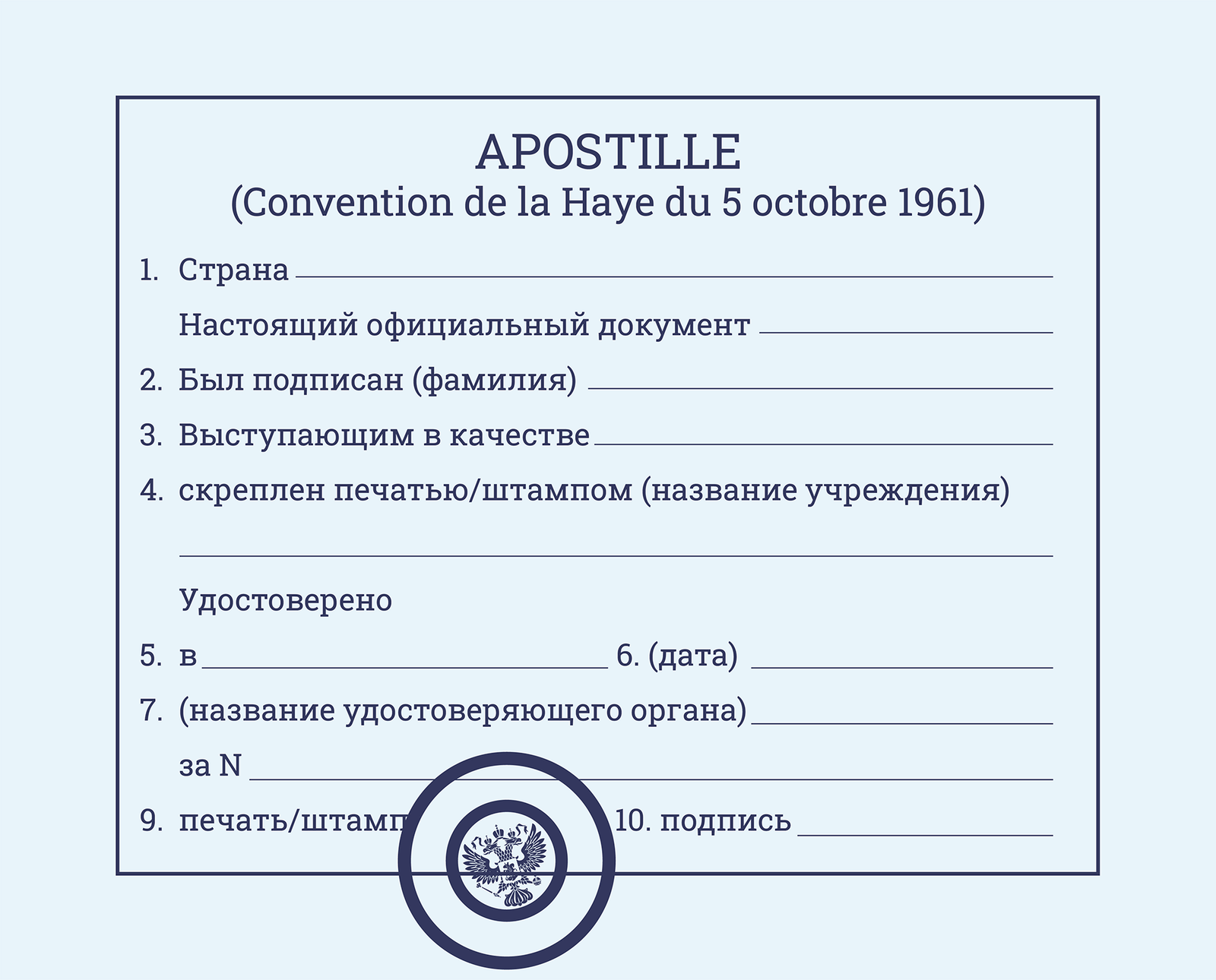
What is an apostille?
An apostille is a simplified form of authentication for public documents intended for international use. It was introduced by the 1961 Hague Convention and was designed to make the cross-border use of official documents easier and more efficient.
The apostille confirms that a public document has been issued, signed or certified by a competent authority. In many contracting states, this allows the document to be used without additional diplomatic or consular legalisation.
Which documents may require an apostille?
Apostilles may be required for a wide range of documents. These include civil status documents such as birth certificates, marriage certificates and death certificates, as well as criminal record certificates, residence certificates, diplomas, academic transcripts, notarised powers of attorney, court documents and commercial register extracts.
Whether an apostille is required depends on the destination country, the type of document and the authority requesting it. In some cases, a certified translation alone is sufficient. In other cases, the apostille must first be obtained and then translated together with the original document.
Why apostille translation requires legal precision
Apostilles appear standardised at first glance, but their translation involves legal terminology, formal wording and official references. They may contain details about the issuing authority, the signatory's official capacity, seals, stamps, register numbers, file references and authentication clauses.
Many of these terms do not have a direct equivalent in another legal system. A literal or imprecise translation can cause misunderstandings, lead to additional questions or result in rejection by the receiving authority.
Apostille and document: what needs to be translated?
In practice, it is often not enough to translate only the apostille. The apostille always refers to a specific public document. Many authorities therefore require a translation of the entire set: the underlying document, the apostille, seals, signatures, stamps, marginal notes and certification wording.
The connection between the apostille and the underlying document must remain clear in the translation. Register details, document numbers, dates of issue and names of authorities should be rendered consistently.
Certified apostille translation into German
If foreign documents are to be used in Germany, German authorities often require a certified translation into German. This may apply to registry offices, immigration authorities, naturalisation offices, courts, universities, recognition offices, notaries, banks or companies.
When translating an apostille into German, legal concepts must be rendered not only accurately, but also in a way that is understandable within the German administrative and legal context. The German recipient must be able to identify which authority issued the apostille and what exactly has been authenticated.
Apostille translation between English, German and Russian
English is widely used in international legal contexts, but legal terminology is not uniform. British, American and international administrative language can differ significantly. Terms such as "public document", "notary public", "registrar", "county clerk", "seal", "capacity" or "authentication" must be translated according to context.
German and Russian authorities also use their own legal concepts and administrative structures. A phrase that is clear in one system may be misleading in another. For this reason, professional apostille translation requires both linguistic accuracy and knowledge of the relevant legal systems.
Apostille translation into English
When apostilles are translated into English, the purpose of use matters. A document intended for a university, a court, a corporate registry, a bank or an immigration authority may require different terminological choices.
The translation should remain precise, formal and legally transparent. It must distinguish between authentication, certification, notarisation, registration and legalisation, as these terms are not interchangeable.
Apostille translation into Russian
Translations into Russian require particular care because Russian authorities use specific terminology for public documents, notarial acts, certifications, registers, official seals and administrative competences.
A translation that is too free or too literal can create ambiguity. Names of authorities, official functions, seals, stamps and register entries must be rendered in a way that remains clear and usable in a Russian-language legal or administrative context.
Typical challenges in apostille translation
Common difficulties include rare legal phrases, official abbreviations, multilingual form templates, handwritten additions, difficult-to-read seals, different date formats and inconsistent spellings of names or places.
Another frequent issue is determining whether the apostille itself, the underlying document or both parts must be translated. A brief review of the document before placing an order can help avoid unnecessary delays.
Who needs apostille translation?
Private individuals
Private individuals often need apostille translations for marriage, naturalisation, residence matters, family reunification, academic study, recognition of degrees, inheritance matters, adoption, divorce or other official procedures.
Companies
Companies may require apostille translations for commercial register extracts, powers of attorney, shareholder resolutions, incorporation documents, certificates, tender documents or international business transactions.
Law firms, notaries and institutions
Law firms, notaries, universities and institutions need precise translations of apostilles when documents are used in international proceedings, court matters, academic procedures or recognition processes.
Nachtigal Services supports private individuals, companies, law firms and institutions with certified translations of apostilles and the related documents in English, German and Russian.
How to order your apostille translation
Send a scan or photo
Send a clear scan or photo of the apostille and the related document. For the first assessment, the original document is usually not required.
Receive a quote
You will receive information about the price, processing time and next steps. The document will be checked to determine whether only the apostille, the underlying document or both parts need to be translated.
Receive the certified translation
After confirmation, the apostille will be translated carefully and with precise legal terminology. The completed certified translation can be used for authorities, courts, law firms, companies, universities or other institutions.
Order your certified apostille translation: Send your apostille and the related document as a scan or photo and receive an individual quote for the certified translation.
Certified apostille translation throughout Germany
You can order certified apostille translations from anywhere in Germany or abroad. Nachtigal Services assists clients in Berlin, Hamburg, Munich, Cologne, Frankfurt, Düsseldorf, Stuttgart, Dortmund, Essen, Recklinghausen and many other cities.
The process is simple: send your document digitally, receive a quote and obtain a certified translation for official use.
Questions about your apostille?
If you are unsure whether the apostille, the underlying document or both parts need to be translated, you can send a scan or photo. I will review the document and let you know what needs to be considered for the certified translation.