
Certified Diploma and School Certificate Translation into German
Russian–German and English–German · Translator authorised by OLG Hamm
A diploma, school certificate or academic record is important proof of education and professional qualification. If you need to submit educational documents in Germany, universities, employers, recognition offices and public authorities may require a certified translation into German.
Certified diploma translations may be needed for university applications, job applications, visa procedures, professional recognition, naturalisation or other administrative processes. The translation must accurately reproduce the document so that the receiving institution can understand the information. A translation does not itself establish recognition or equivalence of a qualification.
Nachtigal Services translates diplomas, school certificates, transcripts, academic records, graduation certificates, supplements and qualification documents from Russian and English into German, with careful attention to terminology, content and document layout.
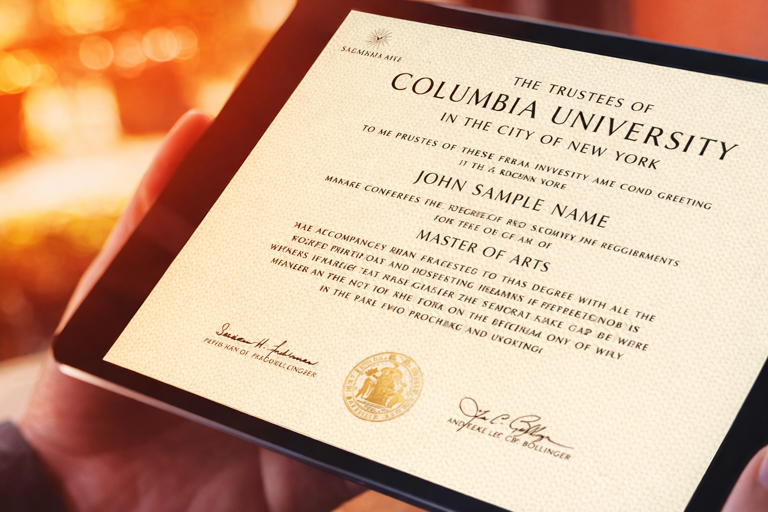
When do you need a certified diploma translation?
A certified translation may be requested when foreign educational documents are submitted to a German university, employer, recognition office, chamber, immigration authority or another institution.
There is no universal requirement to translate every foreign diploma or certificate. Some procedures accept documents in English or allow other forms of submission. Always check the requirements of the receiving institution before ordering.
German institutions must be able to understand the level, content and scope of your education. For this reason, names, dates, grades, subjects, qualification titles, institution names, stamps and signatures must be translated accurately and consistently.
Do you need a translation for ZAB or recognition in Germany?
The Central Office for Foreign Education (ZAB) issues Statements of Comparability for foreign university degrees. A Statement of Comparability explains how a qualification relates to the German education system.
It does not, by itself, authorise work in a regulated profession or guarantee admission to a university.
A certified German translation is not automatically required for every ZAB application. The ZAB Pre-Check and online application specify which documents and translations must be submitted. The original-language documents remain necessary; a translation cannot replace them.
Requirements for professional recognition, university admission and school certificate assessment vary by profession, federal state and receiving institution. Ask the competent office which documents and languages it accepts before commissioning a translation.
What information does a diploma contain?
A diploma usually contains the graduate's name, the name of the educational institution, the qualification awarded, the field of study, the date of issue, registration details, signatures, seals and official statements about the completed programme.
Many educational documents also include a supplement, transcript or grade report. These pages can be especially important because they show the subjects studied, grades received, hours completed, examinations passed, internships, final projects and other relevant academic details.
Diploma supplements, transcripts and grade reports
Educational documents from Russia and other countries often include detailed supplements or grade reports. These documents help German institutions understand not only the title of the qualification, but also the content, duration and level of the programme.
For recognition procedures, admissions offices and employers, the supplement may be just as important as the diploma itself.
Whether the supplement must also be translated depends on the specific application requirements.
Russian diplomas and academic records
Russian diplomas often consist of the diploma certificate itself and an accompanying supplement (Приложение к диплому) listing subjects, hours, examinations and grades. Both parts may be required for academic or professional recognition in Germany.
When translating Russian educational documents into German, special attention is paid to degree titles, specialisations, academic institutions, grading terminology, seals, registration numbers and official wording.
Nachtigal Services also translates Russian-language educational documents issued in former Soviet republics, including older Soviet diplomas. The language of the document, rather than solely its country of origin, determines whether the translation falls within the available language combinations.
School certificates and graduation documents
School certificates, graduation certificates and academic records may be required for school admission, university entrance, vocational training, recognition of prior education or applications to public authorities.
These documents may contain subjects, final grades, school years, examination results, conduct notes, signatures, seals and official remarks. All relevant details must be translated clearly so that the receiving institution can review the document properly.
Why educational translations require precision
Diploma and certificate translation is more than a simple transfer of words from one language to another. Educational systems differ significantly between countries. Qualification names, grading systems, academic titles and institutional structures must therefore be handled carefully.
Even small mistakes in names, grades, subjects, dates or qualification titles can cause delays or problems during an application process.
A professional certified translation helps German institutions understand your documents more easily and reduces the risk of avoidable questions.
Grades, subjects and education systems
Grades and assessment systems may differ from German grading conventions. Subjects, credit hours, examination types, practical training and final theses must be translated in a way that reflects the original document accurately.
The translation reproduces the original grades and academic information without treating them as equivalent to German grades or qualifications.
Decisions on grade conversion, recognition or academic equivalence belong to the competent institution or authority.
Stamps, seals and official formatting
Diplomas, certificates and transcripts often contain stamps, seals, signatures, watermarks, registration numbers, serial numbers or security features. These elements can be important for the completeness of the certified translation.
Legible stamps, seals, signatures and other relevant markings are translated or described as appropriate.
The translator's certification confirms the accuracy and completeness of the translation; it does not certify that the original document is genuine.
Who needs diploma and certificate translation?
Students and university applicants
Students and applicants may need certified translations for university admission, Studienkolleg, master's programmes, doctoral applications, exchange programmes or scholarship applications in Germany.
Professionals and job applicants
Professionals may need translated diplomas, certificates, transcripts or training records for job applications, professional recognition, licensing procedures or proof of qualifications for employers.
Recognition offices and public authorities
Recognition offices, immigration authorities, naturalisation offices, chambers, public authorities and other institutions may request certified translations to assess education, training and professional qualifications.
Nachtigal Services provides certified translations of diplomas, school certificates, transcripts, academic records, certificates and supplements for German universities, employers, recognition offices and public authorities.
How to order your diploma translation
1. Send a scan or photo
Send clear scans or photos of your diploma, school certificate, transcript, academic record, graduation certificate or supplement. For the initial quotation, the original document is usually not required.
2. Receive a quote
You will receive information about the price, processing time and next steps. The quote depends on the number of pages, readability, document type, tables, stamps and the intended use of the translation.
3. Receive the certified translation
After confirmation, your documents are translated into German and provided with the translator's certification statement.
You can submit the translation to universities, employers and authorities subject to their document and submission requirements.
Ordering online does not mean that a scanned paper translation will be accepted as an electronically certified document.
Order your certified diploma or school certificate translation: Send your diploma, school certificate, transcript or supplement as a scan or photo and receive an individual quote for the certified German translation.
Certified diploma translation throughout Germany
You can order certified translations of diplomas, school certificates and academic records from anywhere in Germany or abroad.
Nachtigal Services serves clients in Recklinghausen, Bochum, Dortmund, Essen, Duisburg, Gelsenkirchen, Herne, Oberhausen, Münster and other cities in the Ruhr area and North Rhine-Westphalia.
The ordering process is simple: send your documents digitally, receive a quote and obtain your certified German translation in the agreed form.
The receiving institution determines whether it accepts a scan, paper copy or a particular electronic format.
Questions about your diploma or certificate?
Send a clear scan or photo of your diploma, school certificate, transcript or supplement to request a quote.
I review your documents for translation purposes only — including language, legibility, page count, terminology and the scope of work.
I do not determine whether a translation is legally required in your individual recognition or immigration procedure, or whether your qualification will be recognised.
Please confirm submission and recognition requirements with the competent authority or institution before ordering.